
The chronicle of the TISZA government, written by an independent journalist. On 12 April 2026, the party of Péter Magyar, the Respect and Freedom Party, known briefly as the TISZA Party, achieved a historic victory. Our site records the story of the new government.

TISZA Government 2026: the story of systemic change, day by day
The chronicle of the TISZA government is an independent journalistic project.
The purpose of the site is to follow, in a clear, chronological and source-based way, the most important decisions, personnel changes, reforms and European policy shifts of the period following the 2026 change of government.
After the parliamentary election of 12 April 2026, Hungary entered a new political chapter. The Respect and Freedom Party won 141 seats in the 199-member National Assembly, giving it a broad parliamentary mandate to form a government and reshape the structure of the state.

The Chronicle of the TISZA Government
The formation of the TISZA government after the 2026 parliamentary election marks the beginning of a new political era in Hungary. The creation of the cabinet reflects a change of government, a realignment of parliamentary power relations and the reorganisation of the structure of state operations.
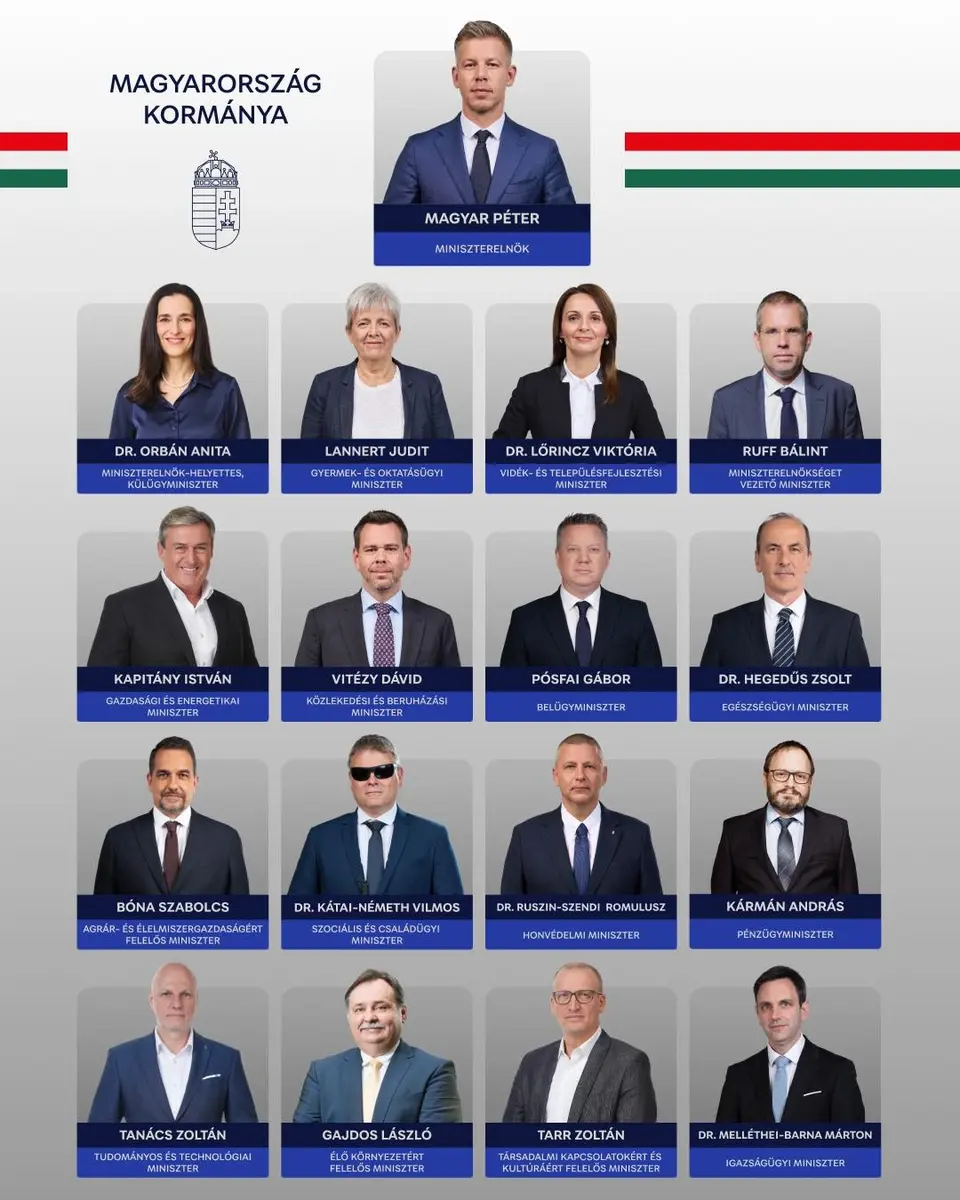
Members of the TISZA Government
We present the leadership of the TISZA government, the key political figures, the parliamentary background and the main framework of the cabinet’s formation. The overview also covers the structural foundations of government operations, leadership roles and the institutional framework of the new term.
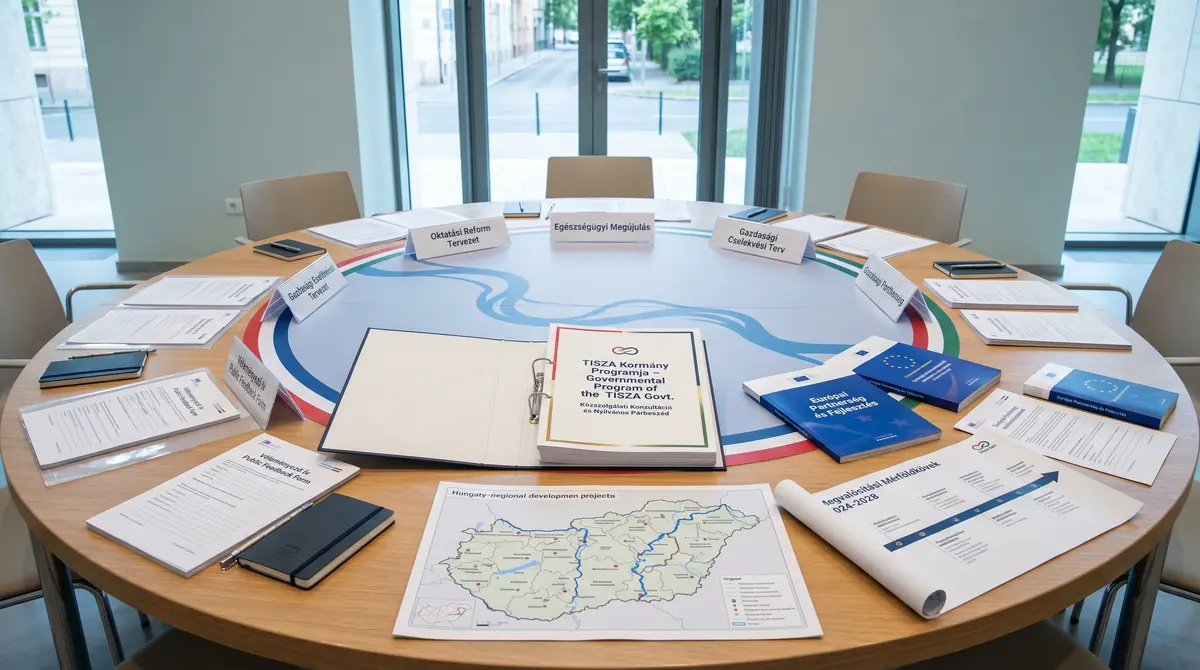
The Programme of the TISZA Government
In the initial phase of the government term, particular attention is given to decisions affecting the functioning of the state organisation and international relations. The early period is expected to define the cabinet’s governing style and legislative pace.
Transparent memory instead of daily news noise
The first months after a change of government bring rapid decisions, strong political messages and legal processes that are often difficult to follow. The Chronicle of the TISZA Government helps readers see in one place what happened, when it happened, what decision was made, who made it and what consequences it may have.
The goal is simple: to build a clear, accurate and traceable civic memory.
An independent journalistic perspective
The portal is not an official government website, not a party site and not a campaign platform. Its editorial work is based on documentation, source criticism and chronology. According to the current imprint-style wording on the site, the website is informational in nature and operates without collecting data.
The timeline of the TISZA government
The timeline follows the main stages of government formation, the first decisions, parliamentary steps, bills, appointments and international negotiations. Each entry appears with a date, a short explanation and a source reference.
Members of the government and their areas of responsibility
Readers can quickly review who makes up the cabinet, which minister is responsible for which area, what professional background they bring and which first measures are connected to the given ministry. The current menu structure of the site already contains separate subpages for government members, so the homepage should provide strong card-based entry points to these pages.
Programme, reforms and the first hundred days
The government programme and the first hundred days deserve special attention. After the electoral mandate, the rule of law, anti-corruption measures, relations with the European Union and the state of public services may move to the centre of the first political debates. According to Reuters, Péter Magyar promised anti-corruption action and reforms linked to the release of EU funds.
Date of the 2026 Hungarian parliamentary election
12 April 2026.
Party forming the government
Respect and Freedom Party, known briefly as TISZA. (Official list of the TISZA Party.)
Number of parliamentary seats
141 out of 199.
National party-list result
3,103,500 votes, 53.07 percent.
Final result (all votes)
3,385,890 votes, 53.18 percent. (National Election Office.)
Prime Minister
Péter Magyar.
Founding meeting of the TISZA Government
9 May 2026.
Members of the incoming TISZA government
The incoming TISZA government is organised with 16 ministries. The cabinet is led by Péter Magyar as prime minister, with Foreign Minister Anita Orbán serving as his deputy. Within the government structure, education, healthcare, social and family affairs, the living environment, and science and technology each receive separate ministries.
The TISZA Party’s actual final national party-list result was 3,385,890 votes, equal to 53.18 percent of the party-list vote. The party won 141 seats in the 199-member Hungarian National Assembly.
Cabinet leadership
Péter Magyar – Prime Minister
The head of the TISZA government. His role is to define the political direction of the cabinet, coordinate government work and oversee the institutional changes arising from the electoral mandate.
Anita Orbán – Minister of Foreign Affairs, Deputy Prime Minister
The head of the foreign affairs ministry and deputy to the prime minister. She previously served as Hungary’s travelling ambassador responsible for energy security, then worked in international corporate and diplomatic fields. Her studies include diplomacy, international law, history and economics.
Bálint Ruff – Minister heading the Prime Minister’s Office
As head of the Prime Minister’s Office, he is responsible for the operation of the government centre and the coordination of institutional reforms. He is a lawyer, political analyst and adviser who has worked on several domestic campaigns, gaining national recognition through his appearances as a public affairs analyst.
Economy, finance and energy
István Kapitány – Minister for Economy and Energy
István Kapitány leads the ministry responsible for economy and energy. He has had an international executive career, previously working at Shell and holding senior positions in several countries. Between 2020 and 2025, he served as president of the National Association of Managers.
András Kármán – Minister of Finance
András Kármán leads the finance ministry. An economist, he began his career at the Hungarian National Bank, later served as chairman of the board of the Government Debt Management Agency, and then worked as state secretary responsible for tax and financial regulation in the second Orbán government.
Rule of law, law enforcement and defence
Gábor Pósfai – Minister of the Interior
Gábor Pósfai leads the Ministry of the Interior. He previously held management roles in Decathlon’s Hungarian and Austrian operations, then became operational director of the TISZA Party. In addition to law enforcement, supervision of sport is also linked to the ministry.
Dr. Márta Görög – Minister of Justice
Dr. Márta Görög, officially Dr. Törőcsikné Prof. Dr. Márta Görög, is a Hungarian jurist, university professor, dean of the Faculty of Law and Political Sciences at the University of Szeged and head of the Institute of Civil Law Sciences. Her academic work is mainly connected to civil law, personality rights, protection of personality rights, intellectual property law, and contracts related to technology and knowledge transfer.
Romulusz Ruszin-Szendi – Minister of Defence
Romulusz Ruszin-Szendi leads the defence ministry. During his military career, he served in several officer positions. In 2021, he was appointed Chief of the General Staff of the Hungarian Defence Forces, and he was relieved of that post in 2023.
Education, healthcare and social affairs
Judit Lannert – Minister for Children and Education
Judit Lannert is an economist, social policy expert and education researcher. For several decades, she has worked on school system performance, educational inequalities and teacher policy issues. She previously worked as a researcher at the National Institute of Public Education and later established her own research centre.
Zsolt Hegedűs – Minister of Health
Zsolt Hegedűs is an orthopaedic surgeon and lower-limb specialist. He obtained his medical degree in 1994, later worked in Great Britain and returned to Hungary in 2015. His professional focus is patient-centred healthcare.
Vilmos Kátai-Németh – Minister for Social and Family Affairs
Vilmos Kátai-Németh is a lawyer and equal opportunities expert. As a visually impaired person, he has personal experience of the situation of people living with disabilities. He has worked as a therapeutic masseur, martial arts instructor and lawyer, and also deals with equal opportunities law.
Transport, rural development and agriculture
Dávid Vitézy – Minister for Transport and Investment
Dávid Vitézy leads the ministry responsible for transport and investment. He previously served as CEO of the Budapest Transport Centre, director general of the Hungarian Museum of Science, Technology and Transport, and later as state secretary for transport. In 2024, he ran as a candidate for mayor of Budapest, and later led the Podmaniczky Movement’s group in the Budapest Assembly.
Viktória Lőrincz – Minister for Regional and Rural Development
Viktória Lőrincz leads the ministry responsible for regional and rural development. She was born in Kaposvár, holds legal and financial qualifications, and worked as a trainee lawyer. In 2024, she ran in the mayoral election in Kadarkút and later became a municipal representative.
Szabolcs Bóna – Minister responsible for Agriculture and the Food Economy
Szabolcs Bóna is an agricultural engineer and president-director of Rábapordány Agricultural Ltd. For years, he has been a national delegate of the Hungarian Chamber of Agriculture and a board member of the Hungarian Pig Breeders and Pig Farmers Association.
Environment, technology and social relations
László Gajdos – Minister responsible for the Living Environment
László Gajdos is the minister responsible for environmental affairs. He is the director of the Nyíregyháza Zoo, head of the Hungarian Association of Zoos and Aquariums, and an honorary citizen of Nyíregyháza. His professional career is linked to animal protection, nature conservation and institution-building.
Zoltán Tanács – Minister responsible for Science and Technology
Zoltán Tanács leads the ministry responsible for science and technology. He worked as a consultant for more than 25 years and became a partner at the international consultancy Horváth in 2009. His responsibilities include digital public services, state data assets, innovation and technological development.
Zoltán Tarr – Minister responsible for Social Relations and Culture
Zoltán Tarr is a Reformed pastor, former vice-president of the TISZA Party and former Member of the European Parliament. He previously held senior positions in the Reformed Church in Hungary, and later worked in digitalisation, support for civil organisations and corporate management.