
Ruff Bálint was formally designated as substitute deputy prime minister while Magyar and Anita Orbán were abroad.
Persons
Péter Magyar; Anita Orbán; Ruff Bálint György.
Areas
Government formation; executive continuity; public administration.
Settlements
Budapest; Warsaw.
At 7:11 in the morning, Portfolio’s running coverage picked up a small-looking entry with the quiet weight of a locked filing cabinet: the Hungarian Gazette had published Ruff Bálint György’s designation as substitute deputy prime minister. The text said Péter Magyar had appointed Ruff to stand in if both the prime minister and Deputy Prime Minister Anita Orbán were prevented from acting. On an ordinary day, such a notice would sink into the grey swamp of official paperwork. On 20 May, with the prime minister and a large ministerial delegation moving through Poland, the notice mattered because the new cabinet was still hardening its bones after the transfer of power.
The signal was administrative, yet political. Magyar’s government was trying to show that the state machine would no longer run on late-night improvisation and personal loyalties. Ruff’s designation also mapped the inner hierarchy of the new executive. Anita Orbán remained the primary deputy, while Ruff became the emergency bridge inside a cabinet still surrounded by old institutional debris. No brass band, no balcony speech, no victory smoke. Just a few lines in the Gazette, the kind of lines that decide who can sign papers when the real storm arrives.
Sources: Portfolio (https://www.portfolio.hu/gazdasag/20260520/tisza-kormany-uj-nemzetkozi-szovetsegest-szerzett-magyar-peter-fontos-bejelentesek-erkeznek-837898).
EU return-policy talks gave Magyar’s government a possible escape route from Hungary’s migration-fine trap.
Persons
Péter Magyar; Magnus Brunner.
Areas
Migration; European Union; asylum policy; EU fines.
Settlements
Brussels; Budapest.
At 8:43, Portfolio reported a Brussels story that landed in Budapest like a bureaucratic crowbar. EU institutions were moving toward an agreement on stricter return rules for rejected asylum seekers, with detention powers, entry bans, sanctions for non-cooperation and the politically explosive idea of “return hubs” outside the Union. Civil groups saw the offshore-centre idea as a legal swamp; the European right saw a chance to harden migration enforcement without waiting for another border crisis. For Magyar’s government, the matter had a brutally practical Hungarian angle: the package could give Budapest a route out of the daily one-million-euro fine tied to Hungary’s earlier breach of EU asylum law.
The old Orbán line had turned migration into theatre and invoice at the same time. Magyar inherited both the slogans’ wreckage and the bill. A tougher common EU rulebook would let the TISZA government argue that Hungary could comply with European law while keeping a strict migration stance. The trick would be delicate. Move too softly, and Fidesz screams surrender. Move too harshly, and Brussels lawyers start sharpening pencils. The May 20 item showed the new cabinet searching for a narrow legal corridor through a problem designed by the previous government for perpetual conflict.
Sources: Portfolio (https://www.portfolio.hu/unios-forrasok/20260520/ugy-paterolna-ki-brusszel-a-bevandorlokat-hogy-azzal-magyar-peter-kormanya-is-kap-egy-mentoovet-837936).
Magyar opened the Polish day with Warsaw and Gdańsk on the schedule, then laid flowers at a monument to Sławik and Antall.
Persons
Péter Magyar; Henryk Sławik; József Antall Sr.; Donald Tusk.
Areas
Diplomacy; Polish-Hungarian relations; historical memory; Second World War.
Settlements
Warsaw; Gdańsk; Budapest.
At 9:14, Portfolio quoted Magyar Péter’s official Facebook post: “Long live the thousand-year Polish-Hungarian friendship,” followed by the note that talks would continue in Warsaw and Gdańsk, with a live stream expected around 9:30. Half an hour later the stream was under way. The programme began with a wreath-laying at the Warsaw monument to Henryk Sławik and József Antall Sr., a gesture heavy enough to cut through the usual diplomatic foam. Sławik helped save thousands of Polish refugees, including Jews, with Hungarian assistance during the Second World War; Antall, as government commissioner, played a decisive role in supporting Polish refugees in Hungary.
Magyar’s team clearly understood the symbolism. Before the microphones, before the smiling handshake with Tusk, before the diplomatic language about V4 renewal, the visit placed the new Hungarian government beside a story of courage, refuge and shared European memory. After years in which Budapest-Warsaw relations were dragged through the mud of party alliances and Russian-adjacent ambiguity, the wreath said what the press release would later stretch across paragraphs: Hungary wanted a reset with Poland at a level deeper than party arithmetic. Then the delegation moved on to the real machinery of the day: Tusk, Sikorski, ministerial meetings and the attempt to drag Central Europe back into working order.
Sources: Portfolio (https://www.portfolio.hu/percrol-percre/837898/magyar-peter-ma-varsoban-es-gdanskban-folytatodnak-a-targyalasok-1035384); Portfolio live coverage (https://www.portfolio.hu/gazdasag/20260520/tisza-kormany-uj-nemzetkozi-szovetsegest-szerzett-magyar-peter-fontos-bejelentesek-erkeznek-837898).
Anita Orbán opened Hungarian-Ukrainian expert talks over minority rights and the rebuilding of bilateral relations.
Persons
Anita Orbán; Andrii Sybiha; Taras Kachka; Péter Magyar; António Costa.
Areas
Foreign affairs; Ukraine; minority rights; sovereignty; Transcarpathia.
Settlements
Budapest; Kyiv; Berehove; Zakarpattia.
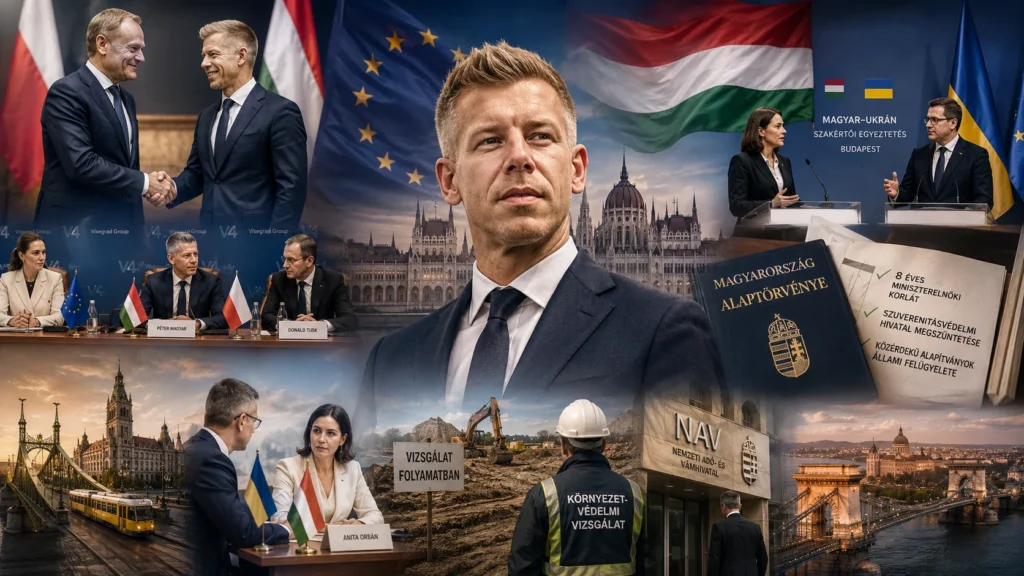
At 9:30, another diplomatic fuse was lit, this time online. Foreign Minister Anita Orbán announced that Hungarian-Ukrainian expert consultations had begun, jointly opened with Ukrainian Foreign Minister Andrii Sybiha and Deputy Prime Minister Taras Kachka. The agenda was the kind that previous governments loved to throw into campaign bonfires: bilateral relations, future cooperation and the rights of the Hungarian minority in Transcarpathia. Orbán said Hungary remained committed to Ukraine’s sovereignty and territorial integrity, while placing national minority rights at the front of the bilateral agenda.
The line was carefully cut. Magyar’s government could not simply pretend the minority issue had vanished; that would have looked cheap in Berehove and reckless in Budapest. Yet the cabinet also needed to bury the old habit of turning every Ukrainian question into a domestic megaphone. Portfolio noted that the new government had already signalled a change of diplomatic direction, including Magyar’s talks with European Council President António Costa. The Ukrainian press followed the same track later in the day, focusing on Magyar’s possible July meeting with Volodymyr Zelensky in Berehove after the consultations. The shape of the move was clear: replace veto theatre with negotiated guarantees. The hard part comes when legal language, schools, language rights and EU accession chapters land on the same table.
Sources: Portfolio (https://www.portfolio.hu/gazdasag/20260520/orban-anita-fontos-bejelentest-tett-egy-uj-folyamat-kezdete-lehet-a-mai-egyeztetes-837952); Ukrinform (https://www.ukrinform.net/rubric-polytics/4125404-magyar-says-may-meet-with-zelensky-in-zakarpattia-region.html).
Magyar and Tusk used their Warsaw press conference to relaunch the V4 and discuss Russian energy dependence.
Persons
Péter Magyar; Donald Tusk; Viktor Orbán; Radosław Sikorski; Zbigniew Ziobro.
Areas
Visegrád cooperation; energy security; EU policy; Ukraine; rule of law.
Settlements
Warsaw; Budapest; Gdańsk; Kraków.
The main Warsaw press conference began shortly after 11:30 and had the temperature of a Central European political thaw after a long, ugly winter. Donald Tusk welcomed Péter Magyar as a friend, saying Poland had been deeply moved by the Hungarian election result and calling Magyar a guarantee that Hungary and Poland would work together in Brussels and other political forums. Magyar answered by inviting Tusk to Budapest before the end of Hungary’s V4 presidency on 30 June, while floating a broader regional format including Romania, Scandinavian partners, Western Balkan states, Croatia, Austria and Slovenia.
Energy was the hard policy beneath the ceremonial warmth. Tusk said Poland had freed itself from dependence on Russian oil and gas, and offered Hungary help through investments and cooperation. Magyar, in turn, spoke of learning from Poland’s experience in recovering EU funds and building modern rail infrastructure. Telex also recorded the Ukraine section of the exchange: Magyar said a longer ceasefire was needed as soon as possible, while Tusk underlined the wider Russian threat after drone incidents and sabotage arrests in Poland. Euronews framed the visit as a bid to make Central Europe stronger inside the EU. The old V4 had become a half-abandoned machine with rust in the joints; on May 20, Magyar and Tusk tried to start it without the old smoke.
Sources: Telex (https://telex.hu/kulfold/2026/05/20/donald-tusk-magyar-peter-lengyelorszag-varso-latogatas-targyalas-sajtotajekoztato); Euronews Hungary (https://hu.euronews.com/2026/05/20/magyar-peter-hivatalos-latogatasra-hivta-donald-tusk-lengyel-miniszterelnokot); Portfolio (https://www.portfolio.hu/gazdasag/20260520/tisza-kormany-uj-nemzetkozi-szovetsegest-szerzett-magyar-peter-fontos-bejelentesek-erkeznek-837898).
Magyar said he could meet Zelensky in Berehove in early July after Hungarian-Ukrainian consultations.
Persons
Péter Magyar; Volodymyr Zelensky; Anita Orbán; Andrii Sybiha; Taras Kachka; Donald Tusk.
Areas
Ukraine; EU accession; minority rights; diplomacy; energy cooperation.
Settlements
Berehove; Zakarpattia; Warsaw; Kyiv; Budapest.
At 12:09, the Ukrainian question moved from expert rooms to head-of-government politics. During the Warsaw press conference, Magyar said he could meet Ukrainian President Volodymyr Zelensky in Berehove in early July after the Hungarian-Ukrainian consultations. Ukrinform carried the line as a separate item at 14:37, while European Pravda focused on Magyar’s condition for Ukraine’s EU accession process: the Hungarian minority must enjoy the same rights as minorities in other EU countries before Budapest agrees to opening the first negotiation cluster.
The sentence was calibrated to survive two audiences. In Kyiv, it signalled that Hungary under TISZA would no longer block Ukraine by reflex. In Hungary, especially among voters sensitive to Transcarpathian Hungarian rights, it signalled that the new government would not trade minority guarantees for Brussels applause. Magyar’s phrase about every EU member helping Ukraine as it has decided also showed the limits of the reset. The TISZA government is pro-European and far colder toward Moscow than the old cabinet, yet it still moves inside Hungarian public opinion, where military and financial aid to Ukraine remain politically loaded. May 20 therefore did not solve the Hungarian-Ukrainian dispute. It did something more useful: it converted a frozen shouting match into a dated diplomatic process, with Berehove placed on the calendar like a test of seriousness.
Sources: Telex (https://telex.hu/kulfold/2026/05/20/donald-tusk-magyar-peter-lengyelorszag-varso-latogatas-targyalas-sajtotajekoztato); Ukrinform (https://www.ukrinform.net/rubric-polytics/4125404-magyar-says-may-meet-with-zelensky-in-zakarpattia-region.html); European Pravda (https://www.pravda.com.ua/eng/news/2026/05/20/8035611/).
TISZA ministers held Polish bilateral talks on economy, energy and transport investment.
Persons
István Kapitány; Andrzej Domański; Dávid Vitézy; Dariusz Klimczak; Péter Magyar.
Areas
Economy; energy; transport; infrastructure; EU funds.
Settlements
Warsaw; Gdańsk; Budapest.
Around noon and early afternoon, the Polish visit became more than prime-ministerial theatre. Portfolio reported that Economy and Energy Minister István Kapitány posted about constructive talks with Polish counterpart Andrzej Domański on Hungarian-Polish economic cooperation. Later, the live coverage added that Transport and Investment Minister Dávid Vitézy, travelling with Magyar’s delegation, had met Dariusz Klimczak, Poland’s infrastructure minister. The precise bureaucratic wording sounds dry until one remembers what Hungary’s new cabinet inherited: frozen EU funds, transport investments wrapped in political patronage, public works inflated by friendly contractors and a railway system whose delays had become a national folk genre.
Poland offered a useful mirror. Tusk’s country had already fought its own post-populist institutional battles and had experience in reopening blocked EU funding channels. Magyar’s government clearly wanted to mine that experience. Vitézy’s track is especially sensitive because transport is where citizens feel state competence in minutes, cold platforms and missed connections. Kapitány’s portfolio is just as exposed: energy prices, industrial policy and investor confidence all sit on his desk, staring at him like unpaid bills. The May 20 ministerial meetings therefore mattered because they translated the Warsaw reset into sectoral work. A government can make foreign-policy gestures in one morning. Rebuilding infrastructure finance and energy cooperation takes the slower discipline of officials, spreadsheets and ministers who know when to stop speaking and start reading contracts.
Sources: Portfolio live coverage (https://www.portfolio.hu/gazdasag/20260520/tisza-kormany-uj-nemzetkozi-szovetsegest-szerzett-magyar-peter-fontos-bejelentesek-erkeznek-837898).
Budapest received a 60-day reprieve in talks with the TISZA government over a major payment obligation.
Persons
Péter Magyar; Budapest city leadership.
Areas
Municipal finance; public budget; solidarity contribution; capital-city governance.
Settlements
Budapest.
At 13:44, Portfolio reported, citing Népszava, that financial talks had begun between the government and the Budapest municipality. The first result was a 60-day payment extension on a 7.5-billion-forint solidarity contribution. On paper, that sounds like accounting. In Budapest politics, it is oxygen. Portfolio noted that the capital faced more than 74 billion forints in obligations by mid-summer, enough to push the city toward the edge of insolvency. The TISZA government’s decision gave the city time, and time in municipal finance is sometimes the only bridge between payroll and panic.
The political reading is sharp. The Orbán system spent years turning Budapest into an enemy city, financially squeezed and rhetorically humiliated whenever convenient. Magyar’s government had the option to continue the punishment machine under new branding. Instead, the first visible move was a delay that opened negotiations. That does not settle the structural dispute over local funding, central extraction and the solidarity contribution. It does show a different governing reflex. Budapest remains a battlefield of money, competence and symbolic power. Every forint has a political fingerprint on it. The May 20 reprieve suggested that the TISZA cabinet wants to own the capital-city problem as a financial settlement task, rather than preserve it as a permanent rage generator for evening television.
Sources: Portfolio (https://www.portfolio.hu/gazdasag/20260520/tisza-kormany-uj-nemzetkozi-szovetsegest-szerzett-magyar-peter-fontos-bejelentesek-erkeznek-837898).
The TISZA government signalled support for EU sanctions against Patriarch Kirill.
Persons
Péter Magyar; Patriarch Kirill; Viktor Orbán.
Areas
Russia; EU sanctions; foreign policy; religion and geopolitics.
Settlements
Brussels; Budapest; Moscow.
At 14:56, Portfolio relayed Euronews reporting that the TISZA government was ready to support EU sanctions against figures previously protected by the Orbán government, with Patriarch Kirill named as the primary example. The detail was brief, yet it carried the weight of a foreign-policy U-turn. Under Orbán, Budapest repeatedly used sanction negotiations as leverage, delay mechanism and ideological signal. Kirill became a symbolic case because the Russian Orthodox patriarch’s political role in the war had made him a target for sanctions, while Hungary’s old government shielded him from EU consensus.
Magyar’s cabinet appears to be changing the rule: Hungary can still have national positions, yet vetoes will no longer function as an all-purpose political crowbar. The likely impact reaches beyond Kirill. Brussels, Kyiv and Warsaw all watch whether Hungary’s new leadership can be trusted in the slow rooms where sanctions lists, accession chapters and funding decisions are negotiated. For the TISZA government, the move also carries risk at home. Fidesz can paint sanctions support as servility to Brussels. Magyar’s answer seems to be that credibility itself has value: a state that blocks everything soon gets nothing when it needs help. The May 20 sanctions signal therefore belonged to the same diplomatic package as Warsaw and the Ukrainian talks. Hungary was telling Europe that the old reflex had lost power.
Sources: Portfolio live coverage (https://www.portfolio.hu/gazdasag/20260520/tisza-kormany-uj-nemzetkozi-szovetsegest-szerzett-magyar-peter-fontos-bejelentesek-erkeznek-837898); Euronews Hungary related listing (https://hu.euronews.com/2026/05/20/alaptorveny-modositast-nyujtott-be-a-tisza-a-miniszterelnoki-ciklus-hosszarol).
Lőrincz Viktória ordered a ministerial probe into suspected BYD soil contamination in Szeged.
Persons
Viktória Lőrincz; Péter Stumpf; László Gajdos.
Areas
Environmental protection; industrial investment; public health; law enforcement.
Settlements
Szeged; Csongrád-Csanád County.
At 16:11, Portfolio reported that Rural Development Minister Viktória Lőrincz had announced a strict ministerial investigation into the Szeged BYD construction case. The suspicion was ugly: soil contaminated with carcinogenic substances may have been spread on surrounding agricultural land. According to the report, the Csongrád-Csanád County government office had already filed a police report after finding that excavated soil had been transported to nearby fields without required prior checks. Portfolio wrote that earlier measurements indicated possible alkylbenzene contamination, and that roughly 20.8 hectares of farmland may have been affected.
The political meaning goes beyond one Chinese industrial project. BYD is exactly the kind of investment every government wants to photograph from the right angle: jobs, export figures, cranes, ribbon-cutting smiles. The hard question begins when the soil under the photograph looks poisoned. Stumpf Péter, the local MP, demanded immediate intervention to protect residents’ health. Lőrincz’s probe aims to clarify both the actual contamination and possible failures by oversight bodies. That second half is the dangerous one. If inspectors missed something, or looked away, the case becomes a test of whether the TISZA government will confront regulatory weakness around flagship investments. Szeged on May 20 became a warning: industrial policy without environmental discipline turns quickly into a bill someone else’s lungs may pay.
Sources: Portfolio live coverage (https://www.portfolio.hu/gazdasag/20260520/tisza-kormany-uj-nemzetkozi-szovetsegest-szerzett-magyar-peter-fontos-bejelentesek-erkeznek-837898).
Kármán András removed a senior NAV official as the new government tightened control over tax authority leadership.
Persons
András Kármán.
Areas
Tax authority; law enforcement; finance ministry; public administration.
Settlements
Budapest.
At 16:45, Portfolio reported, citing Telex, that Finance Minister András Kármán had dismissed the National Tax and Customs Administration’s deputy president responsible for criminal and law-enforcement affairs. The entry was short, but the institution involved makes the story anything but minor. NAV sits at the crossing point of taxes, customs, economic crime and the state’s coercive power over business. Whoever controls its upper floors can shape investigations, enforcement priorities and the rhythm of financial accountability.
The dismissal fitted a wider pattern of personnel changes in the authority’s senior leadership during the first weeks of the TISZA government. Such moves always invite two readings. The charitable reading says a new cabinet needs trusted, competent leadership inside sensitive institutions. The suspicious reading says every incoming power learns quickly how useful those institutions can be. The difference lies in transparency, procedure and the quality of replacements. Kármán’s ministry therefore faces a test that cannot be solved by one dismissal. NAV must become credible to taxpayers and feared by sophisticated fraud networks, not feared by political enemies. May 20 supplied the first visible cut in one of the state’s most sensitive machines. The next question is whether the machine becomes cleaner, sharper and more predictable, or merely receives new hands on old levers.
Sources: Portfolio live coverage (https://www.portfolio.hu/gazdasag/20260520/tisza-kormany-uj-nemzetkozi-szovetsegest-szerzett-magyar-peter-fontos-bejelentesek-erkeznek-837898).
Magyar cancelled two Austrian programme items, while the government kept the Vienna leadership meetings on the agenda.
Persons
Péter Magyar; Vanda Szondi; Christian Stocker; Claudia Bauer; Alexander Van der Bellen; Anita Orbán; Beate Meinl-Reisinger.
Areas
Austria; diplomacy; business relations; government scheduling.
Settlements
Vienna; Göttweig; Budapest.
Telex reported on May 20 that Magyar had cancelled two Austrian programme items scheduled for the following day, citing urgent government business via Der Standard’s reporting. The prime minister would not attend the Wachau Europe Forum at Göttweig Abbey, where he had been expected to speak on Hungary’s return to the European community and Europe’s approach to Russia. His participation in an Austrian Federal Economic Chamber event was also removed from the programme. Government spokeswoman Vanda Szondi told Telex that official visits constantly change as parties coordinate, and that programme points can be added or removed as part of a normal diplomatic process.
The important part is what remained. Magyar was still scheduled to meet Austrian Chancellor Christian Stocker and European Affairs Minister Claudia Bauer in Vienna, and to visit President Alexander Van der Bellen. Anita Orbán was expected to meet Austrian Foreign Minister Beate Meinl-Reisinger. Reports also pointed to a lunch with senior executives of Austrian companies active in Hungary, including Spar, Erste, Raiffeisen, Uniqa, ÖBB Railcargo and Leier. The cancelled speeches therefore did not erase the Austrian visit; they narrowed it toward state and business meetings. After Warsaw’s symbolic glow, Vienna looked like the harder ledger: investors, special taxes, contaminated sites, rail links and the daily accounting of a neighbour whose companies have felt every bump in Hungarian policy.
Sources: Telex (https://telex.hu/belfold/2026/05/20/magyar-peter-becs-ket-program-lemondas).
The TISZA faction submitted its first major proposal package, including an eight-year prime-ministerial limit.
Persons
Péter Magyar; Viktor Orbán; Márton Melléthei-Barna; István Hantosi; Ágnes Forsthoffer.
Areas
Constitution; rule of law; Sovereignty Protection Office; public-interest asset foundations; parliamentary oversight.
Settlements
Budapest.
The day’s domestic climax arrived in the evening. Portfolio reported at 18:53 that the TISZA faction had submitted its first legislative and resolution proposals. Telex and Euronews gave the core of the package: the Fundamental Law would be amended to limit any prime minister to a total of eight years in office, counted retroactively from 2 May 1990. In practice, that would bar Viktor Orbán from returning to the premiership after his long years in power. The proposal was submitted by TISZA MPs Márton Melléthei-Barna and István Hantosi, the latter chairing the Justice and Constitutional Affairs Committee.
The package went beyond the personal shockwave around Orbán. It would create constitutional ground for abolishing the Sovereignty Protection Office, the body created under Fidesz and long criticised as an instrument against media and civil actors. It would also bring public-interest asset management foundations back into constitutional reach by making clear that their assets remain national property and that the state bears direct responsibility for their fate. Those foundations hold or manage major parts of Hungary’s higher education and institutional wealth, including 21 universities and the Mathias Corvinus Collegium ecosystem. The move is political dynamite wrapped in legal paper. The old system moved public assets beyond ordinary democratic control; the new government is trying to pull the thread back through Parliament. May 20 made the TISZA era tangible: the constitutional demolition crew had entered the building.
Sources: Telex (https://telex.hu/belfold/2026/05/20/tisza-part-alaptorveny-modositas-magyar-peter-mellethei-barna-marton); Euronews Hungary (https://hu.euronews.com/2026/05/20/alaptorveny-modositast-nyujtott-be-a-tisza-a-miniszterelnoki-ciklus-hosszarol); Portfolio (https://www.portfolio.hu/gazdasag/20260520/tisza-kormany-uj-nemzetkozi-szovetsegest-szerzett-magyar-peter-fontos-bejelentesek-erkeznek-837898).
Official social-media items identified for 20 May
Direct official / verified social post links found for 20 May 2026
Péter Magyar — Polish-Hungarian friendship, Warsaw and Gdańsk programme
https://www.facebook.com/peter.magyar.102/posts/27507933038814450/
Péter Magyar — Polish reception and Donald Tusk reference
https://www.facebook.com/peter.magyar.102/posts/27510808125193608/
Péter Magyar — Gdańsk walk and Polish-Hungarian public reception
https://www.facebook.com/peter.magyar.102/posts/27514495304824890/
TISZA Párt — Hungarian-Ukrainian expert talks begin
https://www.facebook.com/magyartisza/posts/122234505206331146/
TISZA Párt — Hungarian-Ukrainian expert talks image/post variant
https://www.facebook.com/magyartisza/photos/122234505170331146/
Orbán Anita — Hungarian-Ukrainian expert talks opened online
https://www.facebook.com/orbananita.tisza/posts/122125579827205555/
Kapitány István — meeting with Andrzej Domański
https://www.facebook.com/kapitanyistvan.tisza/posts/122127073893096950/
X.com
Magyar Péter — Polish-Hungarian friendship post on X
https://x.com/magyarpeterMP/status/2022573029184688444