
Sulyok Tamás turned to the Venice Commission, and Magyar Péter answered from Brussels before the EU funds deal was sealed
People
Sulyok Tamás, Magyar Péter.
Areas
presidential powers, Venice Commission, Fundamental Law, constitutional conflict, EU funds.
Places
Budapest, Brussels.
Friday opened with a constitutional flare from the Sándor Palace. President Sulyok Tamás announced that he was turning to the Venice Commission, the Council of Europe’s constitutional advisory body, after Magyar Péter had previously demanded the departure of several public officeholders, including the head of state. Sulyok framed the dispute as a matter of constitutional order: a president must guard the requirements of the Fundamental Law, even when the new parliamentary majority wants speed, reform and political closure after the Orbán years.
Magyar answered quickly and sharply. According to Hungarian press accounts, he claimed that in a private conversation Sulyok had understood the situation and had even asked which minister he should turn to with his resignation. The exchange came at a brutal political moment: the government was in Brussels negotiating the release of EU funds, while the president was signalling that constitutional control could still slow or shape the legislation tied to those funds.
The morning clash therefore carried more weight than a personal quarrel. Sulyok spoke as the custodian of institutional continuity. Magyar treated him as a remaining lock on a door the new majority believes it has the democratic right to open. Before Brussels produced the money headline, Budapest had already produced the question beneath it: who gets to define constitutional caution after a landslide political change?
Sources. 24.hu (https://24.hu/kozelet/2026/05/29/magyar-peter-reagalt-sulyok-tamas-kozlemenyre/), Index (https://index.hu/belfold/2026/05/29/sulyok-tamas-koztarsasagi-elnok-allamfo-magyar-peter-ultimatum-tisza-kormany-velencei-bizottsag-sandor-palota-kozlemeny/), Index (https://index.hu/belfold/2026/05/29/magyar-peter-sulyok-tamas-koztarsasagi-elnok-lemondas/).
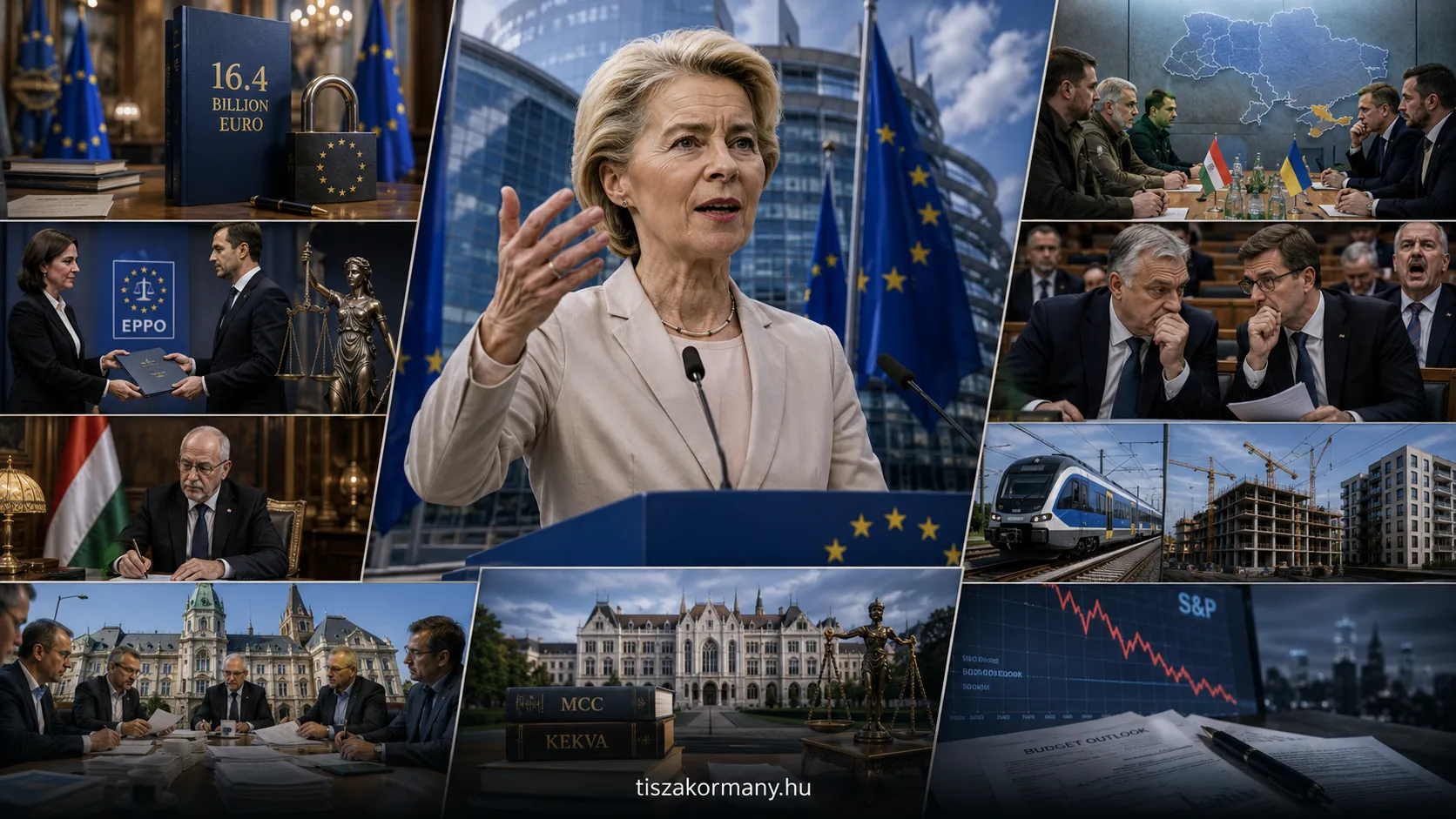
Magyar Péter began the von der Leyen meeting by handing over Hungary’s application to join the European Public Prosecutor’s Office
People
Péter Magyar, Ursula von der Leyen, Kármán András, Vitézy Dávid, Orbán Anita.
Areas
European Public Prosecutor’s Office, anti-corruption policy, EU funds, rule of law, Brussels negotiations.
Places
Brussels, Budapest, Luxembourg.
By midday the centre of gravity had moved from the Sándor Palace to Brussels. Magyar Péter said he would begin his meeting with European Commission President Ursula von der Leyen by handing over Hungary’s official application to join the European Public Prosecutor’s Office. That gesture was aimed with surgical precision. Orbán’s governments had kept Hungary outside the EU’s anti-corruption prosecution framework for years, while corruption and rule-of-law concerns formed the hard concrete around frozen EU money.
The Reuters preview of the day described the urgency clearly: Magyar was in Brussels to conclude a political agreement on the release of frozen EU funds, including recovery money facing an August deadline. The same report noted that Magyar planned to submit Hungary’s request to join the European Public Prosecutor’s Office as part of the anti-corruption turn. Telex’s English-language report also placed the EPPO application at the start of the Brussels meeting, as Magyar himself framed the talks as one of the most important negotiations of recent years.
This was the clean symbolic sequence of the day. First, Hungary enters the European anti-fraud structure. Then, Hungary asks Brussels to unlock the money. The order mattered. Magyar wanted the Commission, the markets and Hungarian voters to see the same image: Budapest was no longer asking for trust on credit; it was offering institutional surrender to external scrutiny.
Sources. Reuters (https://www.reuters.com/world/europe/hungarys-pm-says-he-will-conclude-political-deal-eu-funds-with-von-der-leyen-2026-05-29/), Telex English (https://telex.hu/english/2026/05/29/magyar-in-brussels-we-have-agreed-on-the-release-of-eur16-4-billion), HVG (https://hvg.hu/vilag/20260529_magyar-peter-europai-ugyeszseg-csatlakozasi-kerelem), Facebook / Magyar Péter (https://www.facebook.com/peter.magyar.102/posts/elindultunk-az-ut%C3%B3bbi-%C3%A9vek-legfontosabb-t%C3%A1rgyal%C3%A1s%C3%A1ra-6000-milli%C3%A1rd-forint-uni%C3%B3s-/27619446747663078/).
Brussels agreed to unlock €16.4 billion, and Magyar sold the deal as Hungary’s return to Europe with money on the table
People
Magyar Péter, Ursula von der Leyen, Viktor Orbán, Kármán András, Vitézy Dávid, Orbán Anita.
Areas
EU funds, recovery funds, cohesion funds, Erasmus, public procurement, Integrity Authority, KEKVA system.
Places
Brussels, Budapest.
Early afternoon delivered the number that swallowed the whole day: €16.4 billion. Reuters reported that the European Commission agreed to unlock previously frozen recovery and cohesion funds after reforms by Hungary’s new government. Von der Leyen said Hungary’s progress would allow the release of €10 billion from the EU recovery fund, €4.2 billion in cohesion money, and a further €2.2 billion tied to reform steps. AP gave the story the same historical frame: the EU was releasing money frozen under Orbán after rapid democratic and institutional changes under Magyar.
Telex’s English report quoted Magyar’s message that Hungary was bringing home EU funding the Hungarian people were entitled to, while the previous government had lied about why the money was frozen. Euronews and Al Jazeera also framed the deal as a major win for the newly elected prime minister, with Brussels moving from punishment under Orbán to reward under Magyar.
Politically, the deal did two things at once. It gave Magyar cash for railways, housing, energy, universities and public services. It also gave him a story simple enough to survive any campaign noise: the money did not disappear because of Brussels hatred; it froze because the Hungarian state lost the confidence of its own European partners. On 29 May, Brussels returned with a cheque, conditions and a camera-ready embrace.
Sources. Reuters (https://www.reuters.com/business/eu-agrees-unlock-billions-funds-hungary-von-der-leyen-2026-05-29/), AP News (https://apnews.com/article/8e560d62f308b004f104d6f5b3a15353), Telex English (https://telex.hu/english/2026/05/29/magyar-in-brussels-we-have-agreed-on-the-release-of-eur16-4-billion), Euronews (https://www.euronews.com/my-europe/2026/05/29/hungary-unlocks-164bn-in-eu-funds-after-magyar-secures-deal-with-brussels), Al Jazeera (https://www.aljazeera.com/news/2026/5/29/eu-to-release-billions-in-frozen-funds-for-hungary-amid-magyar-reforms).
International coverage treated the Brussels agreement as a reset of Hungary’s EU relationship, while Ukraine remained the unresolved file on the table
People
Magyar Péter, Ursula von der Leyen, Viktor Orbán, Volodymyr Zelenskyy.
Areas
international press, European Union, rule-of-law reforms, Ukraine’s EU accession, Transcarpathian Hungarian minority rights.
Places
Brussels, Budapest, Kyiv, Transcarpathia.
The international press did not treat the Brussels deal as a technical budget decision. Reuters wrote that the Commission had agreed to release €16.4 billion after reforms by the new government. AP described the decision as a dramatic shift in EU–Hungary relations after Orbán’s 16-year rule. The Guardian broadened the frame, linking the release of funds to changes in Hungary’s rights and rule-of-law climate, including the police approval of Budapest Pride after earlier conflict over the event. Deutsche Welle likewise put the focus on reforms and the scale of the money.
Chinese and Turkish coverage followed the money. Xinhua reported the €16.4 billion agreement, CGTN carried breaking-news style updates on the EU funds talks, and Anadolu framed the story as the EU unlocking billions after reform progress under the new government. Spanish and German outlets, including El País and Welt, also carried the release as a post-Orbán democratic-reform story.
Ukraine-focused coverage looked through a narrower and colder lens. Ukrainian reporting emphasized that the EU money issue had moved, while Ukraine’s accession track remained tied, in Budapest’s language, to Hungarian minority demands in Transcarpathia. That is the diplomatic sting under the Brussels champagne: Magyar may have reopened the European money channel, yet Kyiv still faces Hungarian conditions before the next stage of accession talks can move smoothly. I did not find a separate Israeli May 29 daily item on this exact TISZA-government development in the accessible search results.
Sources. Reuters (https://www.reuters.com/business/eu-agrees-unlock-billions-funds-hungary-von-der-leyen-2026-05-29/), AP News (https://apnews.com/article/8e560d62f308b004f104d6f5b3a15353), Guardian (https://www.theguardian.com/world/2026/may/29/hungarian-police-approve-budapest-pride-despite-previous-ban), Deutsche Welle (https://amp.dw.com/en/eu-unblocks-16-billion-in-hungary-assistance-as-magyar-promises-reforms/a-77349350), Xinhua (https://english.news.cn/20260529/f38d52fe1fb14c79b3054fb7866fa33f/c.html), CGTN (https://news.cgtn.com/news/2026-05-29/news-1NxSzW15vqg/p.html), Anadolu (https://www.aa.com.tr/en/europe/eu-unlocks-billions-in-funds-for-hungary-after-reform-progress-under-new-government/3951350), Kyiv Independent (https://kyivindependent.com/magyar-secures-frozen-eu-money-ukraine-issues-unresolved/).
Orbán Viktor and Bóka János tried to turn the EU deal into a sovereignty trap, while Magyar answered with corruption as the price of release
People
Magyar Péter, Orbán Viktor, Bóka János, Gulyás Gergely.
Areas
EU funds, corruption, migration pact, pensions, tax policy, family tax allowances, domestic political messaging.
Places
Budapest, Brussels.
By late afternoon, the Brussels deal had entered the Hungarian meat grinder. Orbán Viktor demanded that Magyar publish the details of the agreement with von der Leyen and asked what Hungarian interests had been traded away in Brussels. Bóka János pushed the same line, raising the migration pact, the tax system, pensions, family tax allowances and home-support schemes as possible hidden prices of the deal. The old machine reached for its familiar tools: suspicion, sovereignty, fear of Brussels, and the suggestion that money never arrives without national humiliation.
Magyar replied in a short Facebook post that immediately became news. His answer was designed to cut through every technical clause: the only price of bringing home the 6,000 billion forints in EU funds, he wrote, was ending the continuation of Orbán-era corruption. Hungarian outlets picked up the exchange because the political battle over the agreement began within hours of the announcement.
The contrast was almost theatrical. Magyar stood in Brussels saying reform brought the money home. Orbán and Bóka stood in Budapest asking what had been sold. The fight is unlikely to end with the day’s headlines. The TISZA government will try to make every school renovation, train purchase and Erasmus place proof that clean government pays. Fidesz will try to make every condition proof that Brussels bought obedience. The money is real; the story around it has only begun.
Sources. 24.hu (https://24.hu/belfold/2026/05/29/magyar-peter-unios-forrasok-feltetel/), Telex (https://telex.hu/belfold/2026/05/29/magyar-peter-orban-kerdesere-egyetlen-ara-volt-az-unios-forrasok-hazahozatalanak-az-orbani-korrupcio-folytatasanak-megszuntetese), Index (https://index.hu/belfold/2026/05/29/magyar-peter-miniszterelnok-orban-viktor-fidesz-unios-forrasok/), Facebook / Magyar Péter (https://www.facebook.com/peter.magyar.102/posts/egyetlen-%C3%A1ra-volt-a-6000-milli%C3%A1rd-forintos-uni%C3%B3s-forr%C3%A1sok-hazahozatal%C3%A1nak-az-orb/27623099100631176/).
Vitézy Dávid and Radnai Márk began turning the Brussels money into transport, housing and development promises
People
Vitézy Dávid, Radnai Márk, Magyar Péter, Ursula von der Leyen.
Areas
transport development, housing, HÉV, InterCity trains, rental housing, dormitories, cohesion funds, economic recovery.
Places
Budapest, Brussels.
After the Brussels announcement, the question moved from the podium to the invoice. What exactly does €16.4 billion buy? Index reported that Vitézy Dávid, the transport and investment minister, described the deal as a historic success, while Radnai Márk presented it as only the beginning. Portfolio gathered the first available clues about spending priorities. The money could support housing, rental flats, dormitory capacity, HÉV trains, InterCity rolling stock and broader infrastructure development.
This is where the agreement stops being a diplomatic trophy and becomes a governing test. A frozen EU fund can sit in speeches for years. A released EU fund must become timetables, construction sites, procurement documents, network upgrades and keys in the hands of people who cannot afford a city rent. That is the heavier burden of success. Once the money tap opens, every delay becomes visible.
Vitézy’s political role is especially delicate. Transport is one of the few areas where voters feel state failure physically: on platforms, in overheated carriages, in late trains, at bus stops, on broken suburban lines. Housing has the same unforgiving quality. If the TISZA government speaks of abundance, citizens will not measure abundance in Brussels press releases. They will measure it in whether a young nurse, teacher or technician can live near work without donating half a life to rent. May 29 gave the government money. It also gave it a deadline written in everyday impatience.
Sources. Index (https://index.hu/belfold/2026/05/29/radnai-mark-tisza-kormany-magyar-peter-europai-unio-unios-forrasok-vitezy-david/), Portfolio (https://www.portfolio.hu/unios-forrasok/20260529/megjottek-az-elso-informaciok-mire-is-koltheti-el-magyarorszag-a-hatalmas-unios-penzt-839962), Blikk (https://www.blikk.hu/politika/magyar-politika/vitezdy-david-magyar-peter-unios-penzek/fyf7rvp), Telex English (https://telex.hu/english/2026/05/29/magyar-in-brussels-we-have-agreed-on-the-release-of-eur16-4-billion).
Ten non-Fidesz county-seat mayors asked Magyar to ease the solidarity contribution burden on cities
People
Magyar Péter, Botka László, Márki-Zay Péter, Pintér Bence.
Areas
municipal finance, solidarity contribution, city budgets, public services, local government.
Places
Szeged, Hódmezővásárhely, Győr, Budapest.
As Brussels celebrated the billions, Hungarian cities sent in the bill from the ground floor. Ten non-Fidesz mayors of county-seat cities issued a joint statement to Magyar Péter and the TISZA government, asking for a review and reduction of the solidarity contribution. 24.hu reported that the mayors said they were not asking for extra privileges, but for predictable financing aligned with the public services their residents need every day. Index described the contribution as an unbearable burden in the mayors’ argument and reported that Botka László, Márki-Zay Péter and Pintér Bence were among the political figures tied to the appeal.
The timing was ruthless. On the same day Hungary seemed to regain European money, local leaders reminded the prime minister that state finance is not lived in billions; it is lived through street lighting, kindergartens, potholes, social care, local transport and municipal wages. The Orbán years hollowed out much of local-government autonomy through revenue centralisation and political punishment disguised as fiscal design. The mayors’ message to the new government was blunt: do not inherit the old extraction system and call it responsibility.
This is a harder conversation for Magyar than a fight with Fidesz. Opposition mayors are natural allies in the post-Orbán landscape, yet they represent cash-starved cities with immediate needs. If the TISZA government wants a cleaner state, it will have to decide how much financial oxygen flows back to municipalities.
Sources. 24.hu (https://24.hu/belfold/2026/05/29/megyei-jogu-varos-polgarmester-nyilatkozat-magyar-peter/), Index (https://index.hu/belfold/2026/05/29/magyar-peter-tisza-part-szolidaritasi-hozzajarulas-botka-laszlo-marki-zay-peter-pinter-bence/).
Magyar moved against the MCC’s KEKVA foundation, and the institution immediately signalled a survival route
People
Magyar Péter, Melléthei-Barna Márton.
Areas
Mathias Corvinus Collegium, KEKVA foundations, public assets, elite education, foundation wealth, higher-education governance.
Places
Budapest.
The domestic aftershock of the Brussels agreement reached the Mathias Corvinus Collegium by evening. Magyar Péter said the government would abolish the public-interest asset-management foundation maintaining MCC by 31 August. Telex reported that he made the announcement at the Brussels press conference with Ursula von der Leyen, while adding that universities managed by similar foundations would receive a transitional period until 31 August 2027 because some of them also operate hospitals.
The MCC reacted fast. Telex, HVG, 24.hu and 444 all reported that the institution said it would continue as a regular foundation if Parliament abolished the KEKVA structure. The political core is obvious. MCC is more than a school brand. During the Orbán years it became a heavily endowed elite institution, strengthened by public assets, corporate shares, property and a broad ideological ecosystem. 24.hu reported that the MCC foundation’s 2024 balance sheet showed assets worth 505 billion forints. 444 raised the harder question: if the KEKVA shell disappears, what exactly remains of the institution’s property, network and public-asset empire?
The TISZA government is using the KEKVA issue as a test case for recovering public wealth transferred into foundation structures. MCC is using institutional continuity as its shield. The coming fight will be legal, financial and cultural at once: who owns what, who appointed whom, and how much of the Orbán-era elite architecture survives under a new foundation name.
Sources. Telex (https://telex.hu/belfold/2026/05/29/magyar-peter-kekva-alapitvanyok-sajtotajekoztato-brusszel), Telex (https://telex.hu/belfold/2026/05/29/matthias-corvinus-collegium-mcc-kekva-alapitvany-mukodes-magyar-peter), HVG (https://hvg.hu/itthon/20260529_mathias-corvinus-collegium-mcc-megszuntetes-magyar-peter-augusztus-31-bejelentes), 24.hu (https://24.hu/belfold/2026/05/29/mcc-magyar-peter-kekva-alapitvany/), 444 (https://444.hu/2026/05/29/meghalnak-megis-tulelnek-az-mcc-akkor-is-folytatni-akarja-ha-a-mostani-formaban-beszantjak-oket).
S&P gave the Magyar government time, while the fiscal numbers kept flashing red under the Brussels celebration
People
Magyar Péter, Kármán András.
Areas
credit rating, budget deficit, public debt, excessive-deficit procedure, state finances.
Places
Budapest.
The day ended with a cold note from the ratings world. HVG reported that S&P did not change Hungary’s sovereign rating, effectively giving the Magyar government time. Yet the message beneath the unchanged rating was far from warm. According to HVG’s summary, Hungary could still be downgraded to junk if the government fails to stabilise public finances in the next two years, or if external shocks, such as energy-price pressure, damage the fiscal and external position more than expected.
The numbers looked ugly even on a day of European abundance. HVG reported that the budget deficit could reach 6.8 percent of GDP this year and remain at 5.25 percent next year. Public debt may rise to 74 percent in 2027, and Hungary may only exit the EU excessive-deficit procedure in 2030. Economic growth, according to the same report, may be only 1.6 percent this year.
That is the fiscal shadow under the €16.4 billion headline. EU money can buy time, investment and confidence. It cannot magically erase a budget structure weakened by slow growth, high deficit and years of politically driven spending. Kármán András now inherits the job every finance minister claims to want and secretly fears: turning political relief into credible numbers. Brussels opened the gate. S&P left the clock running.
Sources. HVG (https://hvg.hu/gazdasag/20260529_s-p-minosites-hitelminosites-koltsegvetes-allamadossag-tulzottdeficit-eljaras).
Official social media posts reviewed for 29 May 2026
Magyar Péter announced on Facebook that he was leaving for the decisive Brussels talks
Platform
Facebook.
People
Magyar Péter, Ursula von der Leyen.
Areas
EU funds, EPPO accession, Brussels negotiations, anti-corruption policy.
Magyar wrote that he was leaving for the most important negotiations of recent years, with 6,000 billion forints in EU funding at stake. He added that he would begin the talks by handing over Hungary’s official application to join the European Public Prosecutor’s Office. The post set the narrative before the meeting even began: money, Europe, anti-corruption, and a personal prime-ministerial claim of historical stakes.
Magyar Péter explained the “historic agreement” in a Facebook video
Platform
Facebook.
People
Magyar Péter.
Areas
EU funds, government communication, economic recovery, public services.
The post presented the agreement in a five-minute explanation and framed the 6,000 billion forints as money brought home for Hungary. Its political function was clear: after the Brussels press conference, Magyar translated the layered EU-funding package into a domestic victory message built for sharing, quoting and defending in the coming political fight.
Magyar Péter answered Orbán Viktor on Facebook about the “price” of the EU money
Platform
Facebook.
People
Magyar Péter, Orbán Viktor.
Areas
EU funds, corruption, domestic political conflict.
Magyar wrote that the only price of bringing home the 6,000 billion forints in EU funds was ending the continuation of Orbán-era corruption. The post became the shortest political slogan of the day: the deal’s price was reform, and the target was the old system’s money pipeline.
Orbán Anita amplified the 16.4-billion-euro deal on X
Platform
X.com.
People
Orbán Anita, Magyar Péter, Ursula von der Leyen.
Areas
foreign policy communication, EU funds, government messaging.
Orbán Anita’s X feed carried the English-language government line that Hungary would receive €16.4 billion in recovery and cohesion funds, calling the moment historic and tying it to a central campaign pledge. This gave the Brussels announcement a foreign-policy voice beyond Magyar’s own accounts.
Direct account source. https://x.com/_OrbanAnita