
Péter Magyar’s second cabinet meeting turned the transition into a state audit
People: Péter Magyar; András Kármán; Bálint Ruff; Zoltán Tarr; Dávid Vitézy
Areas: government; public administration; budget; state audit; accountability
Places: Budapest; Ópusztaszer
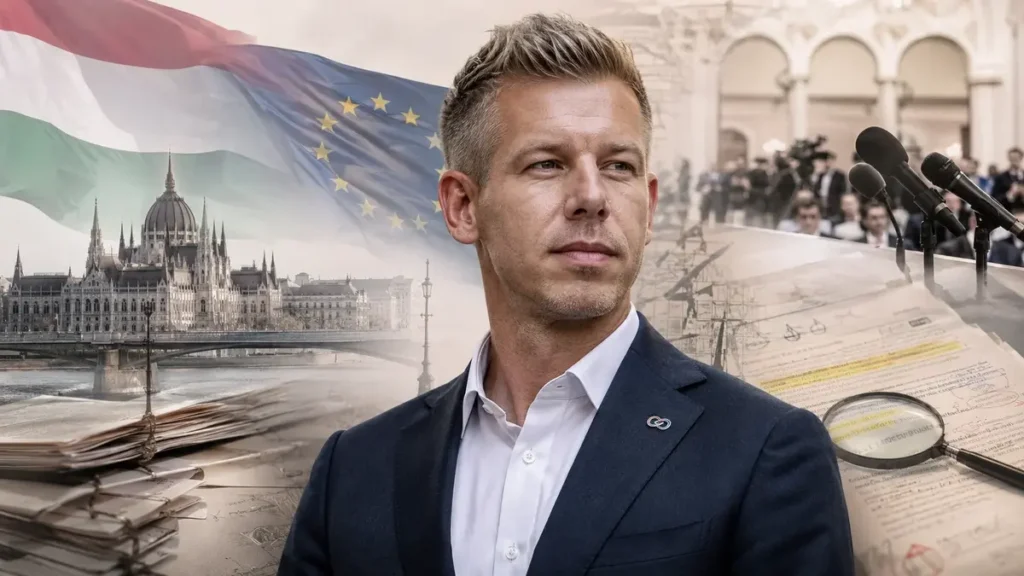
The second meeting of the TISZA government marked a clear shift from the symbolism of taking power to the harder work of taking possession of the state. After the first cabinet meeting in Ópusztaszer, the May 18 meeting in Budapest produced a wide package of decisions touching justice, public finance, state privileges, media, energy, transport and foreign policy. Magyar presented the meeting as a practical audit of the inherited state rather than a conventional press briefing. The list was long because the political message was equally large: the new government wants to examine the systems through which power, money and immunity travelled under the previous administration.
According to 24.hu, 444 and Telex, the cabinet addressed the K. Endre clemency file, the enforcement system, asbestos contamination, the 2026 budget, state contracts, military aircraft use, diplomatic passports, blue-light privileges and the possible publication of earlier cabinet records. The government also decided that cabinet meetings would be recorded going forward, while the documents from the 2010–2026 Orbán era would be reviewed for possible release. That is dry administrative material, yet dry material often carries the clearest evidence.
The political risk is equally plain. Opening files is faster than rebuilding institutions. The May 18 package suggested a government that understands the public appetite for speed, while also entering the slower territory of law, records, deadlines and procedure. Sources: 24.hu (https://24.hu/belfold/2026/05/18/kormanyules-sajtotajekoztato-kormanyinfo-magyar-peter/); 444 (https://444.hu/2026/05/18/a-kegyelmi-ugy-iratai-a-vegrehajtas-atalakitasa-azbesztszennyezes-sajtotajekoztato-a-kormanyules-utan); Telex (https://telex.hu/belfold/2026/05/18/tisza-part-kormanyules-sajtotajekoztato-magyar-peter-kegyelmi-ugy).
The K. Endre clemency file was set for publication, bringing the child-protection scandal back to the paper trail
People: Péter Magyar; K. Endre; Katalin Novák; Judit Varga; Tamás Sulyok; Róbert Répássy
Areas: clemency case; child protection; justice; presidential office; parliamentary inquiry
Places: Budapest; Sándor Palace
The most politically charged decision of the day concerned the K. Endre clemency case. Magyar announced that the justice ministry file would be published on Tuesday on the government’s dedicated “igazságtétel” page. He also called on President Tamás Sulyok and the Sándor Palace to release the presidential version of the file. According to 444 and Telex, Magyar said the justice ministry material already showed that Judit Varga’s submission had not recommended clemency for K. Endre, and that Katalin Novák changed the decision for reasons still requiring public explanation. Sources: 444 (https://444.hu/2026/05/18/a-kegyelmi-ugy-iratai-a-vegrehajtas-atalakitasa-azbesztszennyezes-sajtotajekoztato-a-kormanyules-utan); Telex (https://telex.hu/belfold/2026/05/18/tisza-part-kormanyules-sajtotajekoztato-magyar-peter-kegyelmi-ugy).
The decision carried heavy historical weight. The 2024 clemency scandal shattered confidence in the former government’s child-protection credentials and helped propel Magyar’s political rise. On May 18, the TISZA government returned the affair to the place where responsibility can be checked most directly: routing sheets, ministerial submissions, countersignatures and presidential documents.
Magyar also indicated that a parliamentary inquiry would follow. The key question now goes beyond one act of clemency. The public will want to know how a decision with such moral gravity moved through the state, who saw the warnings, who signed the papers, and which political considerations shaped the final step.
The enforcement, liquidation and notarial systems were placed on the reform track
People: Péter Magyar; Márta Görög
Areas: justice; enforcement; liquidation; notaries; courts; public service
Places: Budapest
The cabinet also moved against one of the most unpopular parts of the legal system: debt enforcement. Infostart reported that the government discussed nationalising and turning enforcement into a nonprofit, state-controlled system. The figures presented at the press briefing were severe: more than 670,000 ongoing enforcement cases in 2024 and over 1.25 million cases that were inactive yet still formally open. Magyar said the new legislation should be prepared by July, with the aim of replacing the profit-driven enforcement model with a public-service structure under state control. Source: Infostart (https://infostart.hu/belfold/2026/05/18/itt-vannak-a-friss-kormanyzati-bejelentesek-frissulo-cikk).
The notarial system was also targeted. Telex reported that the government described the current structure as closed, overpriced and monopolised, with too many public-authority tasks sitting outside proper court control. The justice minister was asked to prepare changes that would move part of the work to government offices and part to the courts, with a cheaper and more transparent public-service model as the declared aim. Source: Telex (https://telex.hu/belfold/2026/05/18/atalakitjak-a-kozjegyzoi-rendszert-is).
This is the sort of reform that sounds technical until a citizen receives an enforcement letter, faces a property seizure, or pays a fee that appears impossible to challenge. Magyar’s political instinct here is sharp: institutional trust often collapses in the small rooms where ordinary people meet closed professional castes.
Kármán András was tasked with a supplementary budget after the government alleged hidden fiscal burdens
People: Péter Magyar; András Kármán; Viktor Orbán
Areas: budget; public finance; deficit; state contracts; fiscal policy
Places: Budapest
The fiscal part of the May 18 press briefing was among the day’s most serious claims. Portfolio and Infostart reported Magyar’s statement that the previous government had falsified the 2026 budget by leaving major payable items outside the official plan. Infostart cited a 286 billion forint missing amount related to the national economy ministry’s area. Magyar said Finance Minister András Kármán must prepare a supplementary budget, while the government also signalled that the SAFE defence-loan framework and other large financial commitments would be reviewed. Sources: Portfolio (https://www.portfolio.hu/gazdasag/20260518/tisza-kormany-az-elozo-kormany-meghamisitotta-az-idei-koltsegvetest-837528); Infostart (https://infostart.hu/belfold/2026/05/18/itt-vannak-a-friss-kormanyzati-bejelentesek-frissulo-cikk).
A new government often blames its predecessor for unpleasant numbers. Markets, ratings agencies and municipal leaders listen with colder ears. They will ask whether the figures are documented, whether the revised budget holds together, and whether the new cabinet can avoid converting inherited problems into fresh uncertainty.
The political line from TISZA is clear: the state’s books require a reset before policy promises can be trusted. The hard part begins after the accusation. Hidden liabilities need exact tables, legal bases, payment dates and ministerial ownership. On May 18, Magyar opened the argument. Kármán now has to make the arithmetic persuasive.
Tarr Zoltán announced a full audit of the public media system
People: Zoltán Tarr; Péter Magyar
Areas: public media; MTVA; Duna Médiaszolgáltató; NMHH; public funds; media governance
Places: Budapest
The government’s audit logic reached the public media system as well. Media1 reported that Zoltán Tarr announced a full review of MTVA and public-service media operations after the cabinet meeting. The audit is set to cover finances, procurement, contract portfolios, editorial practices, leadership decisions, and institutional links involving Duna Médiaszolgáltató and the National Media and Infocommunications Authority. Tarr also pointed to the size of the system: public media support reached 165 billion forints in 2025. Source: Media1 (https://media1.hu/2026/05/18/magyar-peter-kormanya-megkezdi-a-kozmedia-teljes-koru-atvilagitasat/).
For TISZA, the public media question is both democratic and financial. Democratic, because the state broadcaster under the Orbán years became one of the most contested institutions in Hungarian public life. Financial, because a publicly funded media machine must answer for contracts, procurement, staffing and editorial output. Tarr’s announcement placed both questions in the same file.
The strongest line in this story is the connection between money and public function. A media institution funded by taxpayers has to justify more than its budget line. It has to justify its service. The audit will therefore test whether the new government can move from indignation to a credible institutional settlement. A purge would be easy to allege from the other side. A transparent review, published in usable detail, would be harder to dismiss.
The cabinet opened asbestos, Paks and Russian energy contracts as public-risk questions
People: Péter Magyar; Zsolt Hegedűs; István Kapitány
Areas: health; asbestos; energy; Paks; Russian gas; public risk
Places: Budapest; Western Hungary; Vienna; Moscow
The May 18 decisions also touched risk-heavy policy areas that rarely fit neatly into campaign language. Infostart reported that the government decided on action in the asbestos case, nuclear-energy matters, government vehicle use and military aircraft used for state purposes. The cabinet placed the Western Hungary asbestos issue into a health-policy framework, with screening and an action plan under Health Minister Zsolt Hegedűs. Source: Infostart (https://infostart.hu/belfold/2026/05/18/itt-vannak-a-friss-kormanyzati-bejelentesek-frissulo-cikk).
The energy track was equally sensitive. According to the cabinet coverage, the government put Paks I, Paks II and Russian energy-contract transparency under review where publication is legally possible. Those areas sit at the junction of national security, public finance and foreign policy. A nuclear project or long-term gas contract can lock in choices for decades, well beyond one parliamentary cycle.
The logic of the day was consistent: inherited state risk should be recorded, checked and, where possible, made visible. That approach can win confidence if the government publishes enough detail for outside scrutiny. It can also create diplomatic and legal friction, especially around Russian contracts and energy security. The new cabinet is discovering the hard truth of statecraft: transparency has a cost, secrecy has a larger one, and citizens usually receive the bill either way.
The government moved to review state privileges, from blue lights to diplomatic passports
People: Péter Magyar; Bálint Ruff; Tamás Sulyok
Areas: state privileges; diplomatic passports; TEK; official cars; cabinet records; public administration
Places: Budapest
The cabinet’s review of privileges supplied some of the day’s most politically accessible measures. According to 24.hu and Infostart, the government wants to restrict the use of blue lights and review the use of official cars, military aircraft and diplomatic passports. The number of diplomatic passports in circulation, according to the government’s account, was high enough to justify a full check of who needs one and why. Sources: 24.hu (https://24.hu/belfold/2026/05/18/kormanyules-sajtotajekoztato-kormanyinfo-magyar-peter/); Infostart (https://infostart.hu/belfold/2026/05/18/itt-vannak-a-friss-kormanyzati-bejelentesek-frissulo-cikk).
These are the details voters understand quickly. A flashing light, a special passport or a state aircraft can be legitimate in narrow cases. They can also become the visible grammar of a ruling caste. Magyar’s government is trying to cut into that grammar early, before the old symbols settle around the new officeholders.
The cabinet also moved toward recording its own meetings and reviewing the possible release of past cabinet records. That may prove more important than the travel privileges. Cars and lights create images. Records create accountability. If the TISZA government wants to govern differently, the evidence will sit in how decisions are documented, who can inspect them and how long the state can hide them.
Budapest and Kyiv agreed to hold expert consultations on minority rights in Transcarpathia
People: Péter Magyar; Anita Orbán; Andrii Sybiha; Volodymyr Zelenskyy
Areas: Ukraine; minority rights; EU accession; diplomacy; Transcarpathian Hungarians
Places: Budapest; Kyiv; Transcarpathia; Uzhhorod; Berehove
The major foreign-policy development of May 18 came from the Ukraine track. Reuters and AP reported that Hungary and Ukraine agreed to begin consultations on the rights of ethnic Hungarians in western Ukraine. Ukrainian Foreign Minister Andrii Sybiha described his call with Hungarian European affairs minister Anita Orbán as constructive and substantive, while both sides agreed to expert-level consultations focused on practical solutions for minority-rights questions. Sources: Reuters (https://www.reuters.com/world/ukraine-hungary-agree-hold-consultations-hungarian-minority-ukrainian-fm-says-2026-05-18/); AP (https://apnews.com/article/3f2f3d7846e362c153f1378740a11882).
This matters because Hungarian-Ukrainian relations had been strained for years over language, education and minority rights, with Budapest repeatedly using the issue in EU and NATO contexts. The TISZA government has chosen a different opening move: expert talks, a rights-based list and a possible path toward easing the blockade around Ukraine’s EU accession process.
The dispute remains difficult. Budapest is still tying its support for Ukraine’s EU path to guarantees for the Hungarian minority in Transcarpathia. Kyiv wants progress without reopening every earlier conflict. The shift on May 18 lay in tone and method. The megaphone phase gave way to technical negotiation, and technical negotiation is often where real diplomatic repair begins.
Hungary restarted talks with the European Commission over frozen EU funds
People: Péter Magyar; Ursula von der Leyen; András Kármán
Areas: European Union; frozen funds; recovery fund; rule of law; budget
Places: Budapest; Brussels
Reuters reported that Hungary began a new round of talks with the European Commission on May 18 over the release of suspended EU funds. Magyar said he hoped to sign a political agreement in Brussels the following week. The main immediate prize is access to 10.4 billion euros from the EU’s post-pandemic recovery fund, with Hungary facing an August 31 deadline to become eligible. Source: Reuters (https://www.reuters.com/world/hungary-starts-new-round-talks-releasing-eu-funds-pm-says-2026-05-18/).
This file sits at the heart of the new government’s economic strategy. At home, Magyar is arguing that the 2026 budget contains hidden liabilities and inherited damage. In Brussels, he must show that the new government can satisfy rule-of-law and institutional reform conditions quickly enough to unlock money before deadlines bite.
The politics are delicate. A successful agreement would give the government fiscal oxygen and a visible diplomatic win. A slow agreement would leave TISZA with an awkward double burden: claiming a bad inheritance while lacking the European funds needed to ease it. Magyar’s first week has been full of symbolic reversals. The EU-money talks now demand a different skill: converting reform promises into a schedule that Brussels trusts and Hungary can implement.
Sulyok Tamás rejected Magyar’s resignation demand as the presidency became an early institutional battlefield
People: Tamás Sulyok; Péter Magyar; Viktor Orbán
Areas: presidency; constitution; institutional legitimacy; political neutrality
Places: Budapest
Reuters and Anadolu both covered the confrontation between Prime Minister Péter Magyar and President Tamás Sulyok. Reuters reported that Sulyok rejected calls to resign, saying there was no legal or constitutional basis for his departure. Magyar, meanwhile, has framed the election as a regime change and has demanded that officials tied to the Orbán era leave office. Sources: Reuters (https://www.reuters.com/world/hungarian-president-resists-magyars-calls-quit-news-site-reports-2026-05-18/); Anadolu (https://www.aa.com.tr/en/europe/hungarian-premier-renews-resignation-demand-for-president-calling-him-orbans-puppet/3941487).
The presidency is largely ceremonial in daily government, yet it carries delay powers, constitutional symbolism and the authority to send legislation back for reconsideration or constitutional review. That makes Sulyok’s position more than a personal matter. Magyar wants a head of state who matches the new political reality. Sulyok is relying on legal continuity and the formal term of office.
This is the first sharp constitutional argument of the TISZA era. One side speaks the language of democratic mandate and political cleansing after a long dominant-party period. The other speaks the language of office, term and legal continuity. Hungary’s new government can move quickly with its parliamentary strength, but the Sulyok dispute shows that speed will meet institutional resistance where officeholders still hold formal powers.
The international press saw May 18 through EU money, Ukraine and the presidency dispute
People: Péter Magyar; Ursula von der Leyen; Tamás Sulyok; Anita Orbán; Andrii Sybiha
Areas: international press; EU funds; Ukraine; presidency; foreign-policy reset
Places: Budapest; Brussels; Kyiv; Ankara; Beijing; Jerusalem
The international press read May 18 primarily through three lenses. Reuters covered the new round of EU-funds talks and Sulyok’s refusal to resign. AP and Reuters covered the Hungarian-Ukrainian minority-rights consultations. Anadolu gave separate attention to Magyar’s renewed call for Sulyok to leave office, highlighting the institutional tension between the new prime minister and the president. Sources: Reuters EU funds (https://www.reuters.com/world/hungary-starts-new-round-talks-releasing-eu-funds-pm-says-2026-05-18/); Reuters Ukraine-Hungary (https://www.reuters.com/world/ukraine-hungary-agree-hold-consultations-hungarian-minority-ukrainian-fm-says-2026-05-18/); Reuters Sulyok (https://www.reuters.com/world/hungarian-president-resists-magyars-calls-quit-news-site-reports-2026-05-18/); AP (https://apnews.com/article/3f2f3d7846e362c153f1378740a11882); Anadolu (https://www.aa.com.tr/en/europe/hungarian-premier-renews-resignation-demand-for-president-calling-him-orbans-puppet/3941487).
Chinese and Israeli searches did not surface a fresh, separate May 18 TISZA event. CGTN’s closest relevant material was earlier background on Magyar’s reform plans and the government change; Israeli coverage closest to the topic remained earlier reporting on the handover of power. That gap is itself informative. For foreign desks, Hungary’s May 18 story was concentrated where it touched Brussels, Kyiv and the constitutional structure of the post-Orbán transition. Sources: CGTN (https://news.cgtn.com/news/2026-04-14/Magyar-outlines-new-government-s-reform-plans-1MkXaQU3Cbm/index.html); CGTN (https://news.cgtn.com/news/2026-05-09/news-1N0IiXuGfNS/p.html).
The outside reading is simple enough. Hungary’s new government is being judged less by campaign language and more by whether it can restore workable relations with the EU, reduce friction with Ukraine, and handle institutional resistance at home without turning reform into permanent combat.