
The ministries of the TISZA government and their responsibilities are defined in the new government decree. Decree 90/2026. (V. 13.) Government. Decree is one of the least spectacular, yet powerful documents of the Hungarian state organization.
The law, commonly referred to as the statute decree, is not a program speech, campaign material or political statement, but in a legal sense, it still reveals a lot about how the Tisza government wants to operate.
The decree lays down the tasks and powers of the members of the Government, i.e. it determines which ministers are responsible for which matters, which bodies they direct or supervise, how the preparation of decisions is distributed, and what internal work schedule the new government term will start with.
The decree published in the 46th issue of the Hungarian Official Gazette of 13 May 2026 entered into force on 14 May 2026 and at the same time repealed the previous decree 182/2022. (V. 24.) Government Decree.
Why does the Statute Regulation matter?
At first reading, the Statute Regulation appears to be a dry legal text. It contains paragraphs, ministerial names, lists of competences, and institutional legal successions.
In the practice of public administration, however, it determines the basic plan of governance. The establishment and naming of the ministries takes place at the level of law, and the division of powers necessary for the day-to-day work of the government is detailed in the government decree.
The Fundamental Law of Hungary distinguishes between the general executive role of the Government, the statutory list of ministries and the governmental responsibility of ministers. According to the Fundamental Law, the Government is the general organ of the executive power, the list of ministries is regulated by law, and the Prime Minister determines the general policy of the Government.
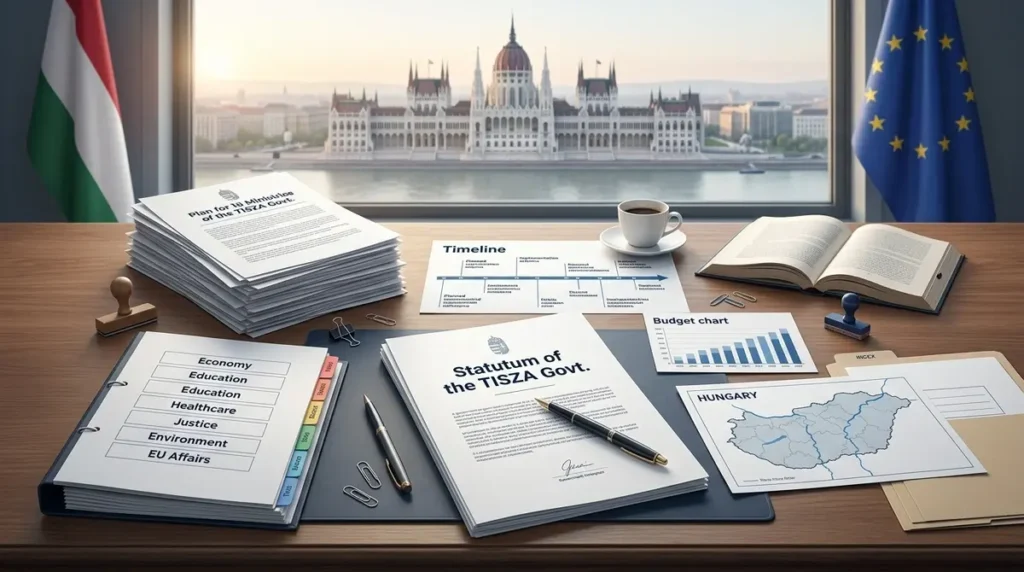
The Statute Regulation is therefore a link between political will and administrative implementation
A new government designates the range of ministries with a ministerial act, and then divides the areas of responsibility with a statute decree. The legal form also says a lot: a law requires a decision by the National Assembly, but the Government creates a government decree within its own competence.
Thus, in the Hungarian constitutional system, the structure of government is arranged on two levels. The National Assembly names the ministries, and the cabinet adapts its own work organisation to the needs of implementation.
According to the XIII. Act lists 16 ministries, and Government Decree 90/2026 regulates the duties and powers of ministers and the bodies subordinate or supervised by them.
The 16 Hungarian ministries
“1. § The ministries of Hungary are as follows:
- Ministry of Health,
- Ministry of Justice,
- Ministry of Education and Children,
- Ministry of Finance,
- Ministry of Agriculture and Food Economics,
- Ministry of the Interior,
- Ministry of the Living Environment,
- Ministry of Economy and Energy,
- Ministry of Defence,
- Ministry of Transport and Investment,
- Ministry of Foreign Affairs,
- Prime Minister’s Office,
- Ministry of Social Affairs and Family,
- Ministry of Public Relations and Culture,
- Ministry of Science and Technology,
- Ministry of Rural and Urban Development.”
The message of the ministerial structure
The 2026 ministerial list breaks with the previous consolidated ministry approach in several respects. Standalone
- Ministry of Health,
- Ministry of Education and Children,
- Ministry of Social Affairs and Family, and
- Ministry of Public Relations and Culture
.
According to the law, the health, education and social affairs ministries will be set up by separating from the Ministry of Interior, while the Ministry of Culture and Social Affairs will be separated from the former Ministry of Culture and Innovation. In the meantime, the Ministry of European Union Affairs and the Cabinet Office of the Prime Minister will be merged into the Prime Minister’s Office.
One reading of the structure is the policy separation
Health, education and social affairs will receive a separate ministerial framework, which in principle creates clearer ministerial responsibilities. Former large ministries often handled law enforcement, public service, social policy and institution maintenance matters at the same time.
One of the advantages of separate ministries is that it is easier to name who is responsible for a hospital reform, a curriculum decision or a family support reform.
In addition to political gain, there is also an administrative risk, because along the new boundaries staff, budgetary rights, background institutional supervision and ongoing cases have to be transferred.
The transitional provisions of the Statute Decree are partly intended to deal with such situations of legal succession.
Act XIII of 2026 also emphasizes the objectives of the TISZA government with new emphasis in the names:
- the Ministry for National Economy will continue to operate as the Ministry of Finance,
- the Ministry of Energy becomes the Ministry of Economy and Energy,
- the Ministry of Construction and Transport will continue as the Ministry of Transport and Investment,
- and the Ministry of Culture and Innovation will be transformed into the Ministry of Science and Technology.
The names designate a completely new administrative direction, because the appearance of finance under a separate name suggests a more disciplined fiscal responsibility, and the linking of economic and energy tasks places competitiveness and energy supply issues in a common decision-making space.
The role of the Prime Minister’s Office
The decree also details the legal status of the prime minister and his role as an organizer within the government. According to the text, the Prime Minister determines the general policy of the Government, directs its implementation, coordinates the activities of the ministers, and is exclusively entitled to submit a proposal to the Government for the adoption or amendment of the Statute Decree.
On the basis of the decree, the Prime Minister organises the work of the Government as a body in addition to defining the general directions of governance, and establishes the internal division of labour between ministers.
The Minister heading the Prime Minister’s Office will have a particularly strong coordinating role
The decree nominates him as the member of the Government responsible for general political coordination, the coordination of European Union affairs, the formulation of EU policies and government communication.
The Prime Minister’s Office will also play a central role in the preparation of cabinet meetings, the organisation of administrative consultations, the management of the legislative programme and the government’s relations with the National Assembly.
The advantage of centralized coordination is faster standardization
In a cabinet with many portfolios, conflicts easily arise on budgetary, European Union, legislative or communication issues. The central government’s organizing force can reduce duplication and bring about more disciplined decision-making.
The risk comes from the same. If coordination is too much focused on policy preparation, ministerial responsibility can become formal, and ministries can act as executive units.
Therefore, a good statute regulation does not merely assign tasks, but creates measurable chains of responsibility – and this is exactly what happens here, as the general obligations of ministers in Regulation 90/2026 include cooperation with other members of the government, the preparation of strategic documents, the elaboration of draft legislation, the governance of institutions and the implementation of EU tasks.
Special situation of the Chief National Security Advisor
The decree devotes a separate subchapter to the Prime Minister’s Chief National Security Advisor. According to the regulation, the Chief Adviser may, on the basis of the Government’s designation, perform tasks of priority in the fields of defence, foreign and domestic policy, national defence, national security, law enforcement, aliens policing, crime prevention, law enforcement, prison enforcement, disaster management or other law enforcement policy tasks.
The duties of the Chief Adviser include coordinating the Prime Minister’s national security, defence and law enforcement activities, strategically monitoring decision-making, and chairing the meetings of the Defence Council.
The provision clearly shows that the government centre does not only play a communication or parliamentary organising role. Security policy coordination is directly linked to the level of the prime minister.
In many places in Europe, defence, national security and law enforcement decisions are linked to the centre of the prime minister, especially in times of crisis, war environment, migration pressure or cyber defence exposure.
The Hungarian model, with its role as chief advisor, creates a political-administrative position that encourages coordination between ministries from above. Efficiency depends on how clear the relations are between the Chief Adviser, the Minister of Defence, the Minister of the Interior, the Minister of Foreign Affairs and the Prime Minister’s Office.
Transition, succession, institutional continuity
A new ministerial structure will not start working by replacing company signs. In the background, there are documents, contracts, budget appropriations, employers’ rights, real estate use issues, ongoing litigation and European Union obligations.
The final provisions of the decree therefore also regulate transitional situations. The Ministry of the Interior, the Ministry of Defence, the Ministry of Justice and the Prime Minister’s Office will continue to operate under the same names, and with regard to the new competences, the legal succession will cover property rights, obligations, asset and infrastructure elements, as well as the employer’s rights over the officials and employees concerned.
The decree also states that in other government decrees or ministerial decrees, the duties and powers of a member of the Government are to be understood in accordance with Decree 90/2026.
The sentence seems technical, but it has significant practical implications. In the legal system, there are many rules that refer to ministerial duties. When a portfolio ceases to exist, separates or continues to operate under a different name, there may be uncertainty in the application of the law due to the old references.
In such a case, the statute decree forms a bridge between the old and the new governmental order.
German example: policy and portfolio responsibility
By European standards, the Hungarian model is closest to the logic of the chancellor-type government, although the Hungarian constitutional environment gives it its own structure.
In Germany, under Article 65 of the Basic Law , the Federal Chancellor sets the general directions of government policy, and federal ministers head their portfolios independently and on their own responsibility within the framework of the policy. In the German legislation, chancellor control, ministerial autonomy and collegiate decision-making of disputes within the cabinet appear side by side.
The parallel is obvious. The Fundamental Law of Hungary also states that the Prime Minister determines the general policy of the Government, and the Minister independently manages the sectors and subordinate bodies within the framework of the Government’s general policy.
The Statute Regulation works well if a healthy ratio is established between the two principles. The direction of the prime minister sets the political framework, and the ministers take their own areas with professional responsibility. If either side becomes predominant, the government will either fall apart into ministerial interests or be squeezed into too narrow a central decision-making channel.
French and Spanish examples: government responsibility and public administration management
According to the Constitution of France , the Government determines and directs the policy of the nation, has the administration of the state and the armed forces, and is accountable to the parliament.
At the same place, the Prime Minister directs the operation of the Government, is responsible for national defence, ensures the implementation of laws, and has the power to issue decrees. The French example is instructive for Hungary because, in addition to formal government responsibility, it works with a strong executive center, while the role of the head of state in the political system is also significant.
The Constitution of Spain also uses a clear formula of executive power. The Government directs domestic and foreign policy, civil and military administration, and the defense of the State, and exercises its executive and decree-making powers in accordance with the laws.
The Spanish solution describes the government as a common center for political control and public administration. From a Hungarian point of view, the comparison is useful because it shows that the detailed details of ministerial powers serve the system of responsibility for implementation in every parliamentary system.
Finnish example: smaller number of ministries, strong coordination
Finland is a state of different sizes and administrative cultures, yet it provides a good counterpoint. According to the Finnish government information, the Government operates with 12 ministries and usually about 20 ministers, and the Prime Minister coordinates the preparation and negotiation of matters falling within the Government’s competence and chairs the ministerial committees.
The English translation of the Rules of Procedure of the Finnish Government presents in detail the tasks of the ministries, the preparation of cases and the internal order of government decision-making.
Based on the Finnish example, the number of ministries alone does not decide the operability of a government: although a smaller number of ministries means a tighter organization, a larger number can create a more detailed policy system.
The decisive question is the quality of coordination
The 16 ministries of the Tisza government represent a structure divided on a Hungarian scale, so the coordinating role of the Prime Minister’s Office, the preparation of cabinet meetings, the uniform management of EU affairs and the discipline of the legislative programme are particularly burdened.
Challenges for the Hungarian model
On the basis of the Statute Decree, the Tisza government strives for both political fragmentation and strong central coordination. The separate ministries for health, education, social affairs, environment, technology and rural development represent more detailed areas of responsibility.
However, the EU coordination returned to the Prime Minister’s Office, the central management of government communication and the role of the chief national security advisor outline a strong prime ministerial centre.
Dealing with the tension between the two directions will be the real test of the regulation
In the first months of operation, there are four areas to pay attention to:
- The first is fiscal discipline, because the new ministries can only pursue independent policies if they are given real responsibility in financial planning.
- The second is the management of EU affairs, as coordination in the Prime Minister’s Office can speed up decisions, while it can also narrow the room for manoeuvre of the ministers in Brussels.
- The third is the practice of institutional succession, as the mass of the personnel, assets and tasks taken over can easily cause administrative congestion.
- The fourth is parliamentary accountability, because a more structured portfolio structure is worth something if ministers can really be held accountable for their own sector before the National Assembly.
Government Decree 90/2026 is therefore not a spectacular political gesture, but rather an operational manual.
The next period of Hungarian governance depends on whether the rules of responsibility set out in the decree are transferred to everyday decision-making. The legislation creates the framework, but the government’s performance will be measured by meeting deadlines, handling disputes between ministries, the quality of legislation and policy results.
Based on European examples, the condition for success is known. We need a strong direction for the head of government, accompanied by actual ministerial responsibility, a predictable transition and parliamentary control that transforms ministerial powers into real political responsibility.